
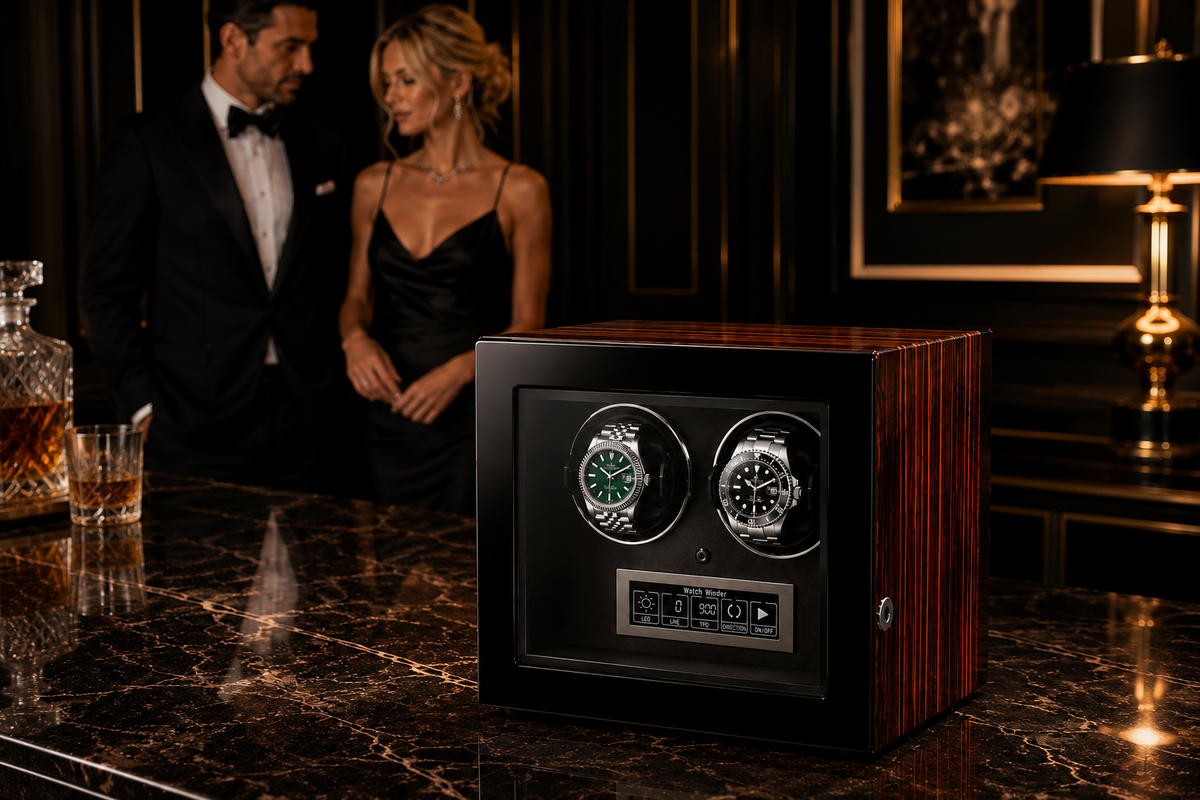
Watch Winder TPD Guide: Settings by Watch Brand & Movement (2026)
Watch Winder TPD Guide: Settings by Watch Brand & Movement (2026)
Choosing the correct watch winder TPD setting is one of the most important steps when setting up a winder for an automatic watch.
TPD stands for Turns Per Day — the approximate number of rotations a watch winder performs over a 24-hour period. The correct setting depends primarily on the movement inside your watch, along with its winding direction.
This guide explains how TPD works, how to choose the right setting, and what to consider for automatic watches from Rolex, Omega, Tudor, TAG Heuer, Breitling, IWC, Longines, Seiko, Grand Seiko, and other manufacturers.
Quick Answer: What TPD Should I Use?
There is no universal TPD setting for every automatic watch.
The correct setting depends on the specific movement inside the watch.
When configuring a watch winder:
-
Identify your exact watch reference
-
Identify the movement or caliber
-
Check its recommended winding direction
-
Determine the appropriate TPD
-
Start with the recommended setting rather than the maximum available
-
Use a winding program that includes rest periods
Many automatic movements can operate with relatively moderate winding requirements, but the correct value should always be verified for the specific caliber.
What Does TPD Mean on a Watch Winder?
TPD means Turns Per Day.
A watch winder rotates an automatic watch to recreate some of the movement normally generated while the watch is worn on the wrist.
Rather than rotating continuously for 24 hours, a properly programmed winder typically divides those rotations into cycles.
For example, the winder may:
Rotate → Rest → Rotate → Rest
throughout the day.
The total programmed rotations make up the approximate TPD.
Why Does TPD Matter?
Automatic watches do not all use identical movements.
Different movements can have different:
-
Winding efficiencies
-
Rotor systems
-
Power reserves
-
Winding directions
-
Recommended daily rotation requirements
This is why simply selecting the highest available TPD is not the best approach.
A watch winder should provide enough rotational activity to help maintain the watch's power reserve without relying on unnecessary continuous movement.
Is Higher TPD Better?
No.
A higher TPD setting is not automatically better.
If a movement can maintain its power reserve with a lower appropriate setting, increasing the number of rotations unnecessarily provides little practical benefit.
The objective of a watch winder is not to rotate the watch as much as possible.
The objective is to provide a suitable winding program for the movement.
Watch Winder TPD Settings by Brand
Brand names are useful for identifying the watch, but they are not enough to determine an exact TPD setting.
Manufacturers often use multiple movements across different models and generations.
Use this table as a guide for what information to verify:
| Watch Brand | What You Should Identify | Recommended Approach |
|---|---|---|
| Rolex | Reference + caliber | Verify movement-specific TPD and direction |
| Omega | Reference + caliber | Verify movement-specific TPD and direction |
| Tudor | Reference + caliber | Verify movement-specific TPD and direction |
| TAG Heuer | Reference + movement | Verify movement-specific TPD and direction |
| Breitling | Reference + caliber | Verify movement-specific TPD and direction |
| IWC | Reference + caliber | Verify movement-specific TPD and direction |
| Longines | Reference + caliber | Verify movement-specific TPD and direction |
| Oris | Reference + caliber | Verify movement-specific TPD and direction |
| Seiko | Reference + movement | Verify movement-specific TPD and direction |
| Grand Seiko | Reference + caliber | Verify movement-specific TPD and direction |
Important: Two watches from the same manufacturer may require different settings.
Always prioritize movement-specific information over a generic brand recommendation.
Rolex Watch Winder TPD Settings
Rolex has used numerous automatic calibers across its collections and throughout different generations.
Models such as the:
-
Submariner
-
Datejust
-
GMT-Master II
-
Daytona
-
Day-Date
-
Explorer
-
Sea-Dweller
-
Yacht-Master
should therefore not automatically be treated as having identical winding requirements.
Before setting up a Rolex watch winder, identify the exact reference and caliber.
Then select the TPD and winding direction appropriate for that movement.
If you need more information, see our Best Watch Winder for Rolex: TPD & Rotation Guide.
Omega Watch Winder TPD Settings
Omega also uses a wide variety of automatic movements.
Different generations and models of:
-
Seamaster
-
Speedmaster Automatic
-
Aqua Terra
-
Planet Ocean
-
Constellation
-
De Ville
may use different calibers.
Many modern Omega watches also incorporate Co-Axial movements with specifications that vary across the range.
For this reason, do not select a TPD setting simply because the watch is an Omega.
Identify the caliber first.
Tudor Watch Winder TPD Settings
Tudor has used both manufacture calibers and movements from external suppliers across different generations.
This means that two Tudor watches can have different winding characteristics.
For models such as:
-
Black Bay
-
Pelagos
-
Ranger
-
Royal
-
1926
check the exact reference and movement before selecting the TPD and rotation direction.
TAG Heuer Watch Winder TPD Settings
TAG Heuer watches can contain a variety of automatic movements depending on the collection, model, and production period.
This applies to collections including:
-
Carrera
-
Monaco
-
Aquaracer
-
Autavia
Determine the exact caliber before configuring your winder.
Breitling Watch Winder TPD Settings
Breitling has produced watches using both manufacture calibers and other movement architectures.
Models within collections such as:
-
Navitimer
-
Chronomat
-
Superocean
-
Avenger
-
Premier
should therefore be configured according to the specific movement rather than using one generic Breitling setting.
Clockwise, Counterclockwise or Bidirectional?
TPD is only one part of configuring a watch winder.
You also need to consider rotation direction.
Most adjustable watch winders provide one or more of the following:
Clockwise (CW)
The watch rotates clockwise.
Counterclockwise (CCW)
The watch rotates counterclockwise.
Bidirectional
The winder alternates between clockwise and counterclockwise rotation.
Some automatic movements can wind in both directions, while others rely primarily on one direction.
Always check the winding characteristics of the specific movement.
Is Bidirectional Rotation Better?
Not necessarily.
Bidirectional rotation sounds more comprehensive, but it is not automatically the ideal setting for every movement.
If a movement is designed to wind efficiently in a particular direction, the correct directional setting may be preferable.
Again, movement compatibility matters more than simply selecting the setting that produces the most rotation.
How to Find Your Watch Movement
If you do not know which movement is inside your watch, start with the watch reference.
You can usually find useful information through:
-
The watch manufacturer's official documentation
-
The owner's manual
-
Reference information supplied with the watch
-
An authorized dealer
-
A qualified watchmaker
-
Reliable movement databases
Search using the exact model reference, not simply the watch collection name.
For example, searching for:
“Rolex Submariner watch winder setting”
is less precise than identifying the exact Submariner reference and caliber first.
How to Set Up a Watch Winder
Step 1 — Identify the Watch
Find the exact manufacturer, model, reference, and caliber whenever possible.
Step 2 — Determine the Winding Direction
Check whether the movement winds clockwise, counterclockwise, or bidirectionally.
Step 3 — Determine the Appropriate TPD
Use reliable movement-specific information to establish the recommended Turns Per Day.
Step 4 — Secure the Watch
Place the watch securely on the pillow or holder.
The watch should remain stable during rotation without excessive pressure on the bracelet or strap.
Step 5 — Select the Appropriate Program
Choose the closest suitable TPD and direction available on your watch winder.
Step 6 — Allow the Winder to Complete Its Cycles
Do not expect the winder to rotate continuously.
Rest periods are a normal part of a properly designed winding program.
Step 7 — Monitor the Watch
If the watch repeatedly stops while on the winder, verify:
-
The TPD setting
-
The rotation direction
-
The watch's initial power reserve
-
Whether the watch is properly positioned
-
The condition of the movement
A watch winder should not be used to diagnose or compensate for a mechanical problem.
Should You Fully Wind a Watch Before Putting It on a Winder?
A watch winder is generally intended to maintain the power reserve of an automatic watch rather than rapidly restore a completely depleted watch.
If your automatic watch has stopped, follow the manufacturer's instructions for restarting and manually winding it before relying on the winder to maintain its power reserve.
This gives the watch winder an appropriate starting point.
How Long Should a Watch Winder Run?
A watch winder does not need to rotate continuously.
A programmed TPD cycle distributes rotation throughout the day with periods of rest.
This means a watch can remain in the winder while the device alternates between active rotation and inactivity according to its program.
The relevant measurement is the winding program — not simply the number of hours the motor appears to be moving.
Can Too Much TPD Damage an Automatic Watch?
Modern automatic movements are designed with systems that manage mainspring tension as the watch reaches a wound state.
However, this does not mean excessive rotation is desirable.
Using unnecessarily high TPD settings can create more movement and mechanical activity than needed.
The better approach is simple:
Use the appropriate TPD for the movement rather than the maximum TPD available.
What If My Watch Still Stops on the Winder?
If an automatic watch stops despite being placed on a watch winder, several factors may be responsible.
First check:
TPD — The programmed number of turns may be insufficient.
Direction — The movement may not wind efficiently in the selected direction.
Starting power reserve — The watch may have been placed in the winder from a fully depleted state.
Positioning — Make sure the watch is securely positioned.
Movement condition — A watch that consistently fails to maintain its power reserve may require inspection.
Increasing TPD should not automatically be the first solution.
TPD for a Collection of Multiple Watches
This is where independent watch winder controls become particularly useful.
Imagine a collection containing:
Watch A: Rolex
Watch B: Omega
Even if both watches are automatic, they may use different movements with different winding requirements.
A double or multi-watch winder with independently controlled positions allows each watch to operate using its own program.
For collectors with several automatic watches, this flexibility can be more important than the total number of winding positions.
What to Look for in an Adjustable Watch Winder
If your collection contains multiple automatic movements, look for:
| Feature | Benefit |
|---|---|
| Adjustable TPD | Allows movement-specific winding programs |
| CW rotation | Supports clockwise-winding movements |
| CCW rotation | Supports counterclockwise-winding movements |
| Bidirectional mode | Supports compatible two-direction movements |
| Rest cycles | Avoids unnecessary continuous rotation |
| Independent controls | Allows different settings for multiple watches |
| Secure watch pillows | Keeps watches stable during operation |
| Quiet motor | Better suited to bedrooms and offices |
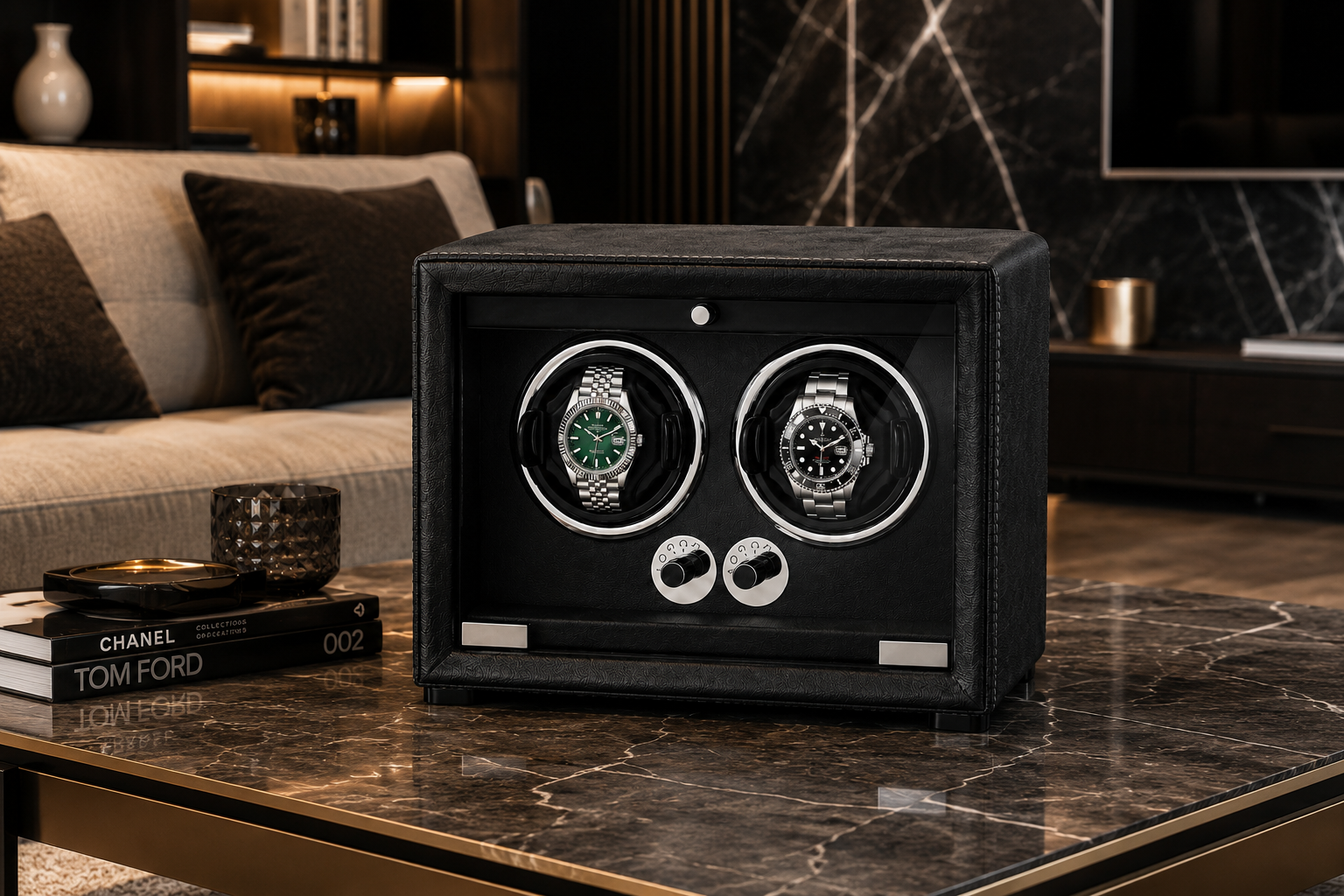
ChronoVelar Adjustable Watch Winders
ChronoVelar offers automatic watch winders for individual watches and larger collections.
Depending on the model, available features may include adjustable TPD programs, multiple rotation directions, independently controlled winding positions, adaptive watch pillows, integrated lighting, and a range of leather and wood finishes.
Before choosing a model, compare its available winding programs with the requirements of the watches in your collection.
For collectors with watches using different movements, independently adjustable positions provide additional flexibility.
Frequently Asked Questions
What does TPD stand for on a watch winder?
TPD means Turns Per Day. It represents the approximate number of rotations programmed over a 24-hour period.
What is the best TPD for an automatic watch?
There is no universal best TPD. The appropriate setting depends on the movement inside the watch.
Is 650 TPD enough?
It may be appropriate for some automatic movements and insufficient for others. Check the requirements of your specific caliber rather than assuming one setting works for every watch.
Is 900 TPD too much?
That depends on the movement. A 900 TPD program may be appropriate for some watches but unnecessary for others.
Should I use clockwise or counterclockwise rotation?
Use the direction appropriate for the movement inside your watch. Some movements wind clockwise, others counterclockwise, and some can wind in both directions.
Can I use bidirectional mode for every watch?
Not necessarily. Bidirectional operation should not be treated as a universal setting. Check the winding characteristics of your movement.
Does a Rolex need a specific TPD?
Different Rolex calibers can have different winding characteristics. Identify the exact reference and caliber before selecting a TPD program.
Why does my watch stop while it is in the winder?
Possible causes include insufficient TPD, incorrect rotation direction, inadequate initial power reserve, improper positioning, or a mechanical issue with the watch.
Should I manually wind my watch before using a watch winder?
If the watch has completely stopped, follow the manufacturer's instructions for restarting and manually winding it. A watch winder is generally better suited to maintaining power reserve than rapidly restoring a fully depleted watch.
Final Thoughts
Choosing the correct watch winder TPD setting starts with one piece of information: the movement inside your watch.
Do not choose settings based solely on brand name, price, or the maximum TPD available.
Instead:
-
Identify the exact watch reference and caliber.
-
Determine the appropriate winding direction.
-
Determine the movement's TPD requirements.
-
Select the closest appropriate program on your watch winder.
-
Allow the winder's rotation and rest cycles to maintain the watch.
For collectors with watches from Rolex, Omega, Tudor, TAG Heuer, Breitling, IWC, Longines, Seiko, Grand Seiko, and other manufacturers, adjustable TPD and independent winding positions provide the flexibility needed to accommodate different automatic movements within the same collection.


%0AChoosing%20the%20correct%20watch%20winder%20TPD%20setting%20is%20one%20of%20the%20most%20important%20steps%20when%20setting%20up%20a%20winder%20for%20an%20automatic%20watc...)