Best Watch Winder for Omega Watches: TPD, Settings & Buying Guide (2026)
Best Watch Winder for Omega Watches in 2026
An Omega automatic watch is designed to be worn, moved, and enjoyed. But if you rotate between several watches, your Omega may spend enough time off the wrist for its power reserve to run down.
That's where a properly configured watch winder can be useful.
Whether you own an Omega Seamaster, Speedmaster Automatic, Aqua Terra, Planet Ocean, Constellation, or De Ville, the right watch winder can help keep your automatic watch running and ready to wear between rotations.
But choosing a watch winder for an Omega isn't simply about finding one that spins.
TPD, rotation direction, movement compatibility, rest cycles, and the quality of the watch holder all matter.
Here's what Omega owners should know before choosing one.
Does an Omega Need a Watch Winder?
Not necessarily.
If you wear your Omega automatic watch every day, normal wrist movement may provide enough winding activity to keep it running.
A watch winder becomes more useful when you:
- Own several watches and rotate between them
- Wear your Omega primarily on weekends or special occasions
- Frequently allow the watch's power reserve to run down
- Prefer your watch to be ready to wear when you pick it up
- Own a model with calendar functions you would rather not reset frequently
For collectors with several automatic watches, a winder can also provide an organized way to display selected pieces while keeping them in motion.
The important point is that a watch winder is a convenience tool, not a requirement for every Omega owner.
Which Omega Watches Can Use a Watch Winder?
Watch winders are intended for automatic mechanical watches.
Omega has produced many automatic models across some of its best-known collections, including:
- Omega Seamaster
- Omega Seamaster Diver 300M
- Omega Seamaster Planet Ocean
- Omega Aqua Terra
- Omega Constellation
- Omega De Ville
- Certain Omega Speedmaster automatic models
However, you should not assume that every watch bearing the Omega name belongs on a watch winder.
This distinction is particularly important with the Speedmaster family.
Some Speedmaster models use manually wound movements. A conventional automatic watch winder does not wind a manual-winding movement through rotor motion.
Always identify whether your specific Omega is automatic before purchasing or configuring a watch winder.
What TPD Should You Use for an Omega?
TPD means Turns Per Day — the approximate number of rotations a watch winder performs over a 24-hour period.
There is no single TPD setting that should automatically be applied to every Omega.
Omega has used numerous movements across different collections, references, and generations.
Even within the Seamaster or Speedmaster families, two watches can contain different calibers.
The correct approach is:
- Identify your exact Omega reference.
- Determine the caliber inside the watch.
- Check the winding requirements for that movement.
- Configure the watch winder accordingly.
- Start with an appropriate setting rather than automatically selecting the maximum TPD.
If you need a broader explanation of how TPD works, read our Watch Winder TPD Guide: Settings by Watch Brand & Movement (2026).
Does Rotation Direction Matter for Omega Watches?
Yes.
Automatic watch winders can generally rotate:
- Clockwise (CW)
- Counterclockwise (CCW)
- Bidirectionally
The appropriate direction depends on the movement inside the watch.
This is another reason why choosing a winder based only on the brand name is not enough.
Rather than asking:
“What direction should every Omega rotate?”
A better question is:
“What winding direction does the caliber inside my Omega require?”
A watch winder offering multiple rotation directions gives you greater flexibility, especially if your collection includes watches from several manufacturers.
Omega Seamaster Watch Winder
The Seamaster family is one of Omega's most recognizable collections in the United States and includes numerous automatic references.
For owners who alternate between a Seamaster and other watches, a winder can keep the automatic movement active while the watch is off the wrist.
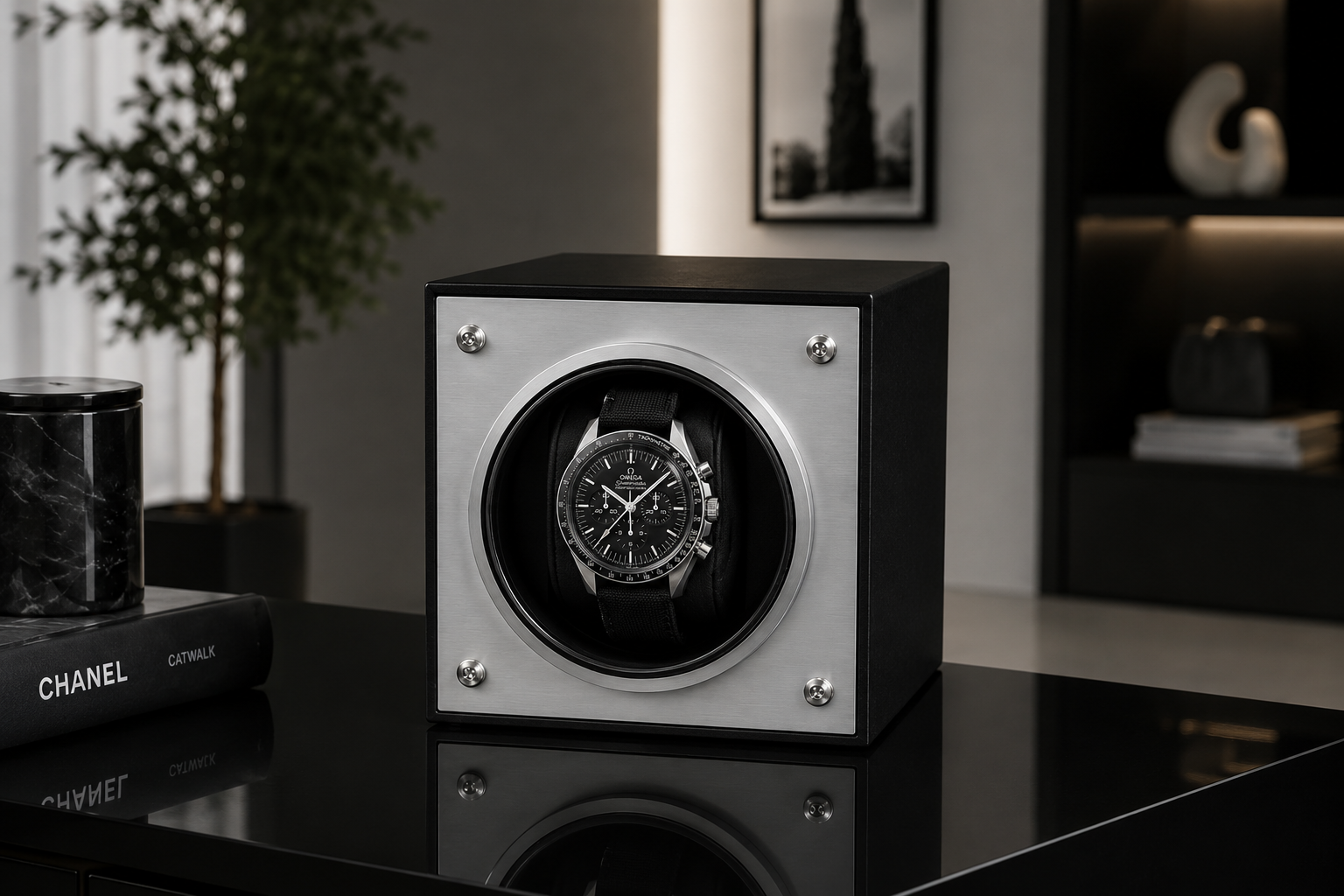
A compact single-watch winder can make sense if your Seamaster is your only automatic watch.
If you own a Seamaster alongside another automatic watch, however, a dual winder becomes considerably more convenient.
The important consideration remains the movement.
A Seamaster Diver 300M and a different-generation Seamaster should not automatically be assumed to require identical settings simply because they share the Seamaster name.
Omega Speedmaster: Check the Movement First
This is particularly important for Speedmaster owners.
The Speedmaster family includes both manual-winding and automatic watches, depending on the model and generation.
A watch winder relies on movement of an automatic rotor.
Therefore, if your Speedmaster uses a manually wound caliber, placing it in an automatic watch winder will not wind the mainspring in the way it would for an automatic watch.
If your Speedmaster is automatic, a compatible watch winder may be useful.
Check your exact Speedmaster reference and caliber first.
This small step can prevent one of the most common mistakes when shopping for a watch winder based solely on the watch's brand or collection.
Omega Aqua Terra Watch Winder
The Aqua Terra is another strong candidate for watch-winder use, particularly for collectors who alternate between dressier and sport-oriented watches.
If your automatic Aqua Terra spends several days off the wrist, an appropriately configured winder can help keep it ready for your next wear.
For someone who owns an Aqua Terra as part of a two- or three-watch rotation, quiet operation and programmable settings become especially useful.
And if your second automatic watch uses different winding requirements, independent winding positions are preferable.
Omega Planet Ocean and Other Automatic Models
The same principles apply to automatic Planet Ocean, Constellation and De Ville references.
The collection name alone should never replace movement-specific information.
Before choosing your settings, verify:
- Exact reference
- Movement/caliber
- Appropriate TPD
- Winding direction
This approach is more reliable than relying on a generic “Omega setting.”
What Should You Look for in a Watch Winder for Omega?
There are several characteristics we consider particularly important.
Adjustable TPD
A watch winder with multiple TPD programs gives you more control over the amount of rotational activity your Omega receives.
Avoid assuming that maximum rotation is automatically better.
Multiple Rotation Directions
Look for clockwise, counterclockwise and/or bidirectional programs.
This makes the winder more versatile and also allows it to accommodate other watches as your collection evolves.
Rotation and Rest Cycles
A quality winder should not simply rotate continuously.
Controlled periods of movement and rest more closely recreate the intermittent activity an automatic watch experiences when worn.
Secure Watch Holder
Your Omega should remain properly supported while rotating.
The holder should accommodate the bracelet or strap without placing unnecessary pressure on the watch.
Quiet Motor
If the winder will be placed in a bedroom, dressing room or office, noise becomes an important consideration.
A quality motor should provide smooth operation without becoming a distraction.
Best ChronoVelar Watch Winder for an Omega Collection
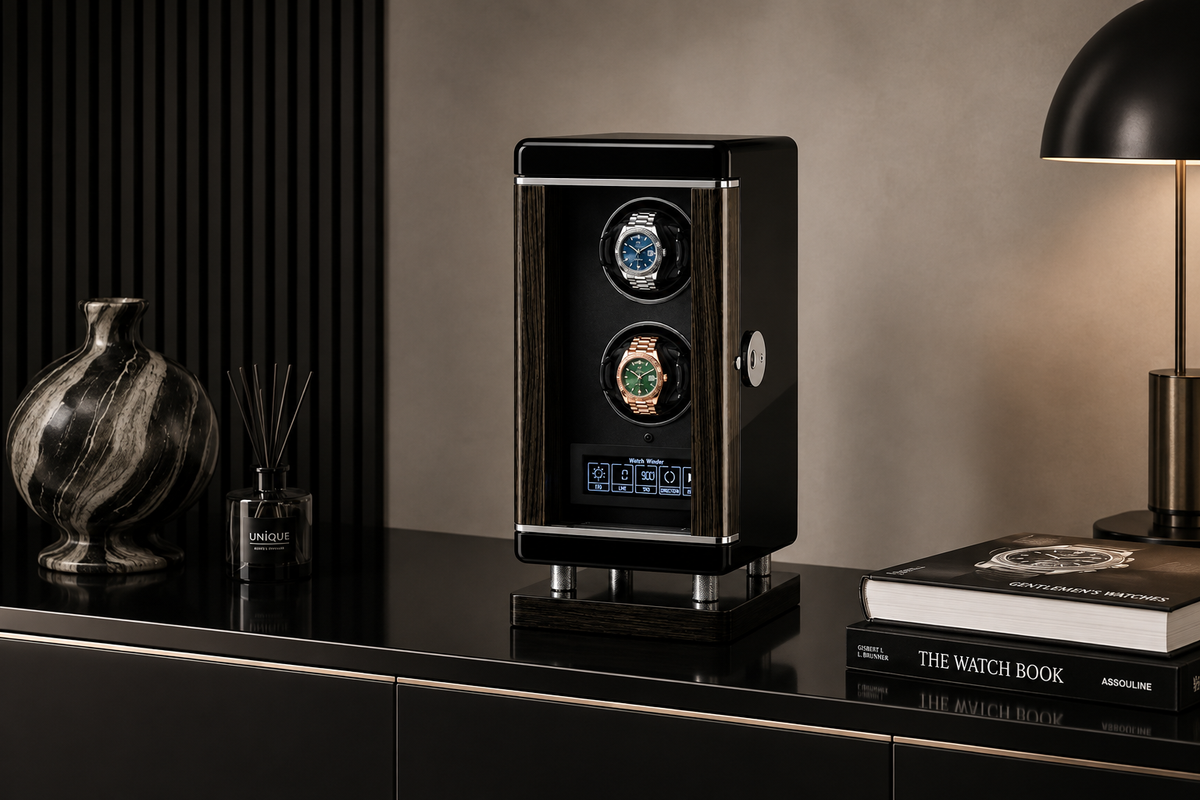
For an Omega owner with two automatic watches — or an Omega alongside another luxury automatic watch — our preferred option is the ChronoVelar Meridian Duo.
The Meridian Duo uses two independent Japanese Mabuchi motors, meaning each winding position can be controlled separately.
It provides 650, 750, 850, 1000 and 1950 TPD settings, along with clockwise, counterclockwise and bidirectional rotation.
That independent control is particularly valuable for mixed collections.
For example, if you own an Omega Aqua Terra alongside a Rolex Datejust, the two watches do not have to be treated as though they contain the same movement.
Each position can be configured independently.
The Meridian Duo also includes adjustable telescopic watch pillows, interior LED lighting, touchscreen and remote controls, and fingerprint access. Its Mabuchi motors are specified by ChronoVelar at below 10 dB.
For a serious two-watch collection, that combination of independent control and presentation makes it especially relevant.
What if You Only Own One Omega?
You don't necessarily need a large multi-watch winder.
If you own a single automatic Omega and primarily want a compact place to keep it moving between wears, a single-watch ChronoVelar winder may make more sense.
For example, The Tripod Winder is designed for one automatic watch and provides a much more compact format.
This creates an important distinction when choosing:
One automatic Omega → consider a single-watch winder.
Omega + another automatic watch → consider a dual winder.
Growing luxury watch collection → consider a larger multi-watch system.
Buy for the collection you actually own — or realistically expect to build.
What if You Own Several Omega Watches?
Once a collection reaches four or more watches, capacity and storage become increasingly important.
For collectors who want winding and conventional watch storage in one case, the ChronoVelar 4 Watch Winder – Classiq combines four winding positions with storage for six additional watches, for a total capacity of ten.
Another approach is keeping only your most frequently worn automatic watches on active winding positions while storing the remainder conventionally.
For example, the Saddler's Chest combines two winding modules with eight additional storage compartments.
The right solution therefore depends less on owning “an Omega” and more on how your overall collection is structured.
Can a Watch Winder Damage an Omega?
A properly configured watch winder is intended to provide controlled rotational movement to an automatic watch.
The key words are properly configured.
Using an unnecessarily high TPD or unsuitable rotation program is not the objective.
More rotation does not automatically mean better winding.
You should configure the winder according to the requirements of the specific movement and use controlled rotation/rest cycles.
For a deeper explanation, read our guide Can a Watch Winder Damage a Watch? TPD, Overwinding & Safety Explained.
How to Set Up an Omega on a Watch Winder
Before placing your Omega on a winder:
- Confirm that the watch is automatic.
- Identify the exact model/reference.
- Identify the movement or caliber when possible.
- Verify the appropriate TPD and rotation direction.
- Secure the bracelet or strap correctly around the holder.
- Select the appropriate winding program.
- Monitor the watch over the following days.
If it continues to stop, verify the movement requirements before simply increasing TPD.
The goal is not maximum rotation.
The goal is sufficient, controlled winding.
The Bottom Line
The best watch winder for an Omega is not determined by the Omega logo alone.
It depends on the specific automatic movement inside the watch, the number of watches you own, how frequently you rotate between them, and the level of control you want from your winder.
For a single automatic Omega, a compact single-watch winder may be enough.
For two valuable automatic watches, the ChronoVelar Meridian Duo provides the major advantage of independently configurable winding positions.
And for larger collections, a multi-watch winder or combined winding-and-storage system may make more sense.
Whatever you choose, remember the fundamental rule:
Identify the movement first. Configure the winder second.
That is a better approach than relying on a universal setting for every Omega.